
We’re a family of animal lovers who always have our eyes open for glimpses of animals that are new to us and in their native environment. Much like the list of airlines that I update on this blog, I’ll update the ‘cool animals’ list on a regular basis.
Kookaburra – Newcastle, New South Wales and Fraser Island, Queensland, Australia. Had to judiciously guard my lunch as the Kookaburras are notorious thieves. Their cry is
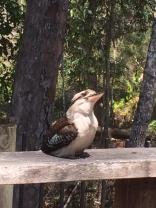
often heard in jungle movies e.g. think Johnny Weissmuller Tarzan movies. Although larger and more imposing, they are similar in shape and flight pattern to a kingfisher.
Giant Clam – Great Barrier Reef, Queensland, Australia. Amazing. Huge. Colorful. Centerpiece of an ocean floor metropolis. I could hover above one of these majestic creatures for hours and observe all the traffic and ongoings in, on, and around it. The clam does what clams do. To witness their immense presence and appreciate what they represent in the Great Barrier Reef is humbling.
Spinner Dolphins – Fraser Island, Queensland, Australia. Was lucky to catch a small pod swimming across the front of our ferry boat. Much smaller dorsal fins promote a stockier, less sleek, appearance. Such a surprise to see them. And then, they vanished.
Sperm Whale – Kaikoura, New Zealand. Our hopes were met when we saw the blowhole spray of this gigantic beast on the horizon. We idled close by as the big fella, known by our boat’s crew, lingered on the surface before diving deep, deep, deep.
Dusky Dolphins – Kaikoura, New Zealand. As so many wildlife encounters are, we were lucky to be in the right place at the right time to come across a playful pod of these beautiful acrobats. Although slightly smaller, they’re more colorful and nimble than other dolphins I’ve seen. Joyful to watch them swim, dart, weave, and jump. Was a surprise ending to what had been a great day.
Bottle Nose Dolphins – Doubtful Sound, New Zealand. Quick glimpse of a pod who quickly moved away from our ferry to protect their new calf – which was exiting news for our crew.
Pronghorn Antelope – South Dakota and Wyoming, USA. I never tire of seeing North America’s speed merchant of the plains, and constantly scan the horizon for their silhouettes while driving across the northern plains. Always at a distance, sharing the landscape with them, and appreciating what they stand for, gives me a sense of peace.

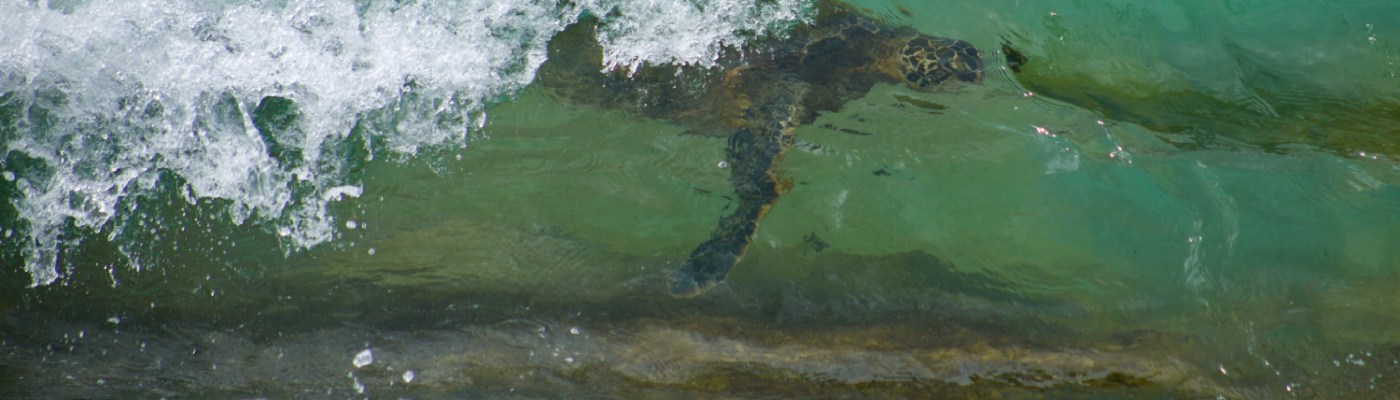
Sea Turtles – Hawaii, USA and Great Barrier Reef, Australia. Sheer beauty, calm, grace,
and wonder. Swimming near sea turtles is one of my favorite things to do in life. I try to parallel their travel, carefully minimizing my movements in attempts to not stress them.
Spectacled Flying Foxes (or the Spectacled Fruit Bat) – Daintree Rainforest and Cairns, North Queensland, Australia. “Are those bats? Look at all of them!” Every night at dusk our sky was filled with these massive mammals silently moving in the same direction at different altitudes. The full sky reminded me of the flying monkeys in ‘The Wizard of Oz.’ More mysterious and intimidating because we were living deep in the forest.
Cockatoo – Australia. The same bird featured in the ‘70s TV show ‘Baretta.’ To see them in abundance in many sections of the east coast of Australia was pure fun. Would often see several together, all perched in the same tree or grazing on the ground together. Watching small flocks seemingly maintain flight speed and formation discipline in the air was novel.
Update as of June 30th:
Angelfish – (Shark’s Cove, Hawaii) Part of the wonder of new experiences is sharing it with your kids. In this instance, K was apprehensive about wading into Shark’s Cove with all its unique underwater paths and pools due to uneven erosion of the volcanic rock. However, after some risk analysis, theory, and gentle coaxing, we moved out to explore the cove as the strong tide filtered in. In one of the deeper pools, we lost time as we observed and followed a pair of beautifully colored angelfish. Looking like kites bobbing in the wind, they effortlessly shifted positions side to side and back to front propelled by the smallest of movements. Their nearly neon-yellow coloring contrasted with the volcanic rock background.
Cassowary – I had never heard of a cassowary until arriving in Northern Queensland. As
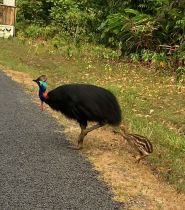
we were coordinating our route and travel, we were warned to take special care to be on the lookout for the rare cassowary – a large land bird that looks like it comes from the dinosaur times. Male cassowaries mind the chicks. Sure enough, while driving out in the boondocks we saw papa and baby along the side of the dirt road.
Kangaroo – We were just tickled the first time we saw a real-life kangaroo jumping alongside our car in Australian wine country. Experiencing kangaroos in the wild is new and exciting for us. Our hosts, and other Australians, politely, yet coolly, tolerated our amazement. In some areas, kangaroos have become a bit of a nuisance and driving hazard. Regardless, to see a full-sized male bounding alongside us, able to bounce over our car at any instant, was a joy for us to see.
Little penguin – Our ‘March of the penguin’ night on Philip Island was an unexpected highlight of our time in Australia. Every night at the same time, about a thousand little blue penguins come out of the ocean and waddle up into the dunes to nest, sleep, and carry on with penguin life. A sanctuary, built up around the penguins’ habitat, charges admission, features a modern visitor’s center, has elevated boardwalks to get visitors safely to the beach and into the roped off bleachers, and on-site naturalists to narrate and answer questions about the penguins. The PA system gives updates in a variety of languages and advises people that it’s prohibited to photograph the penguins for fear of scaring them. First ones there, we sat on the sand just inside the rope, waiting for the magical time for the penguin parade to begin. It got darker and cooler. We waited. Waited some more. Always good to shift positions after sitting on the sand for a while. Someone had to run off to the bathroom, but made it back in time. Chatted with a nice Canadian family who were living in Canberra. Waited some more. Finally, the first penguins appeared in the surf. Seemed like they were scouting out the landing zone for safety. Sure enough, they started marching out. Sometime one-by-one and sometimes in small groups. They made their way out of the surf, awkwardly up the beach, through the predesignated aisles just a few feet away from us, and into the shrubby dunes. Before long, the dunes were alive with the chatter and squawking of penguin sounds. We were warned to watch our step as we carefully departed along the boardwalk. We also followed the guidance to check under our cars before leaving in case any mischief-maker penguins broke standard protocol by wandering outside their routine neighborhood. We experienced an evening full of anticipation, wonder, and humor as we watched the world’s smallest penguins carry on with penguin life.
Sand worm – Fraser Island, Australia. I had never heard of sand worms until our day trip to Fraser Island. Honestly, I had been to Fraser Island before and wasn’t interested in going this time. However, I’m glad I did and I had another very positive, but different, experience while there. One unexpected tidbit was when our tour guide pointed out that the isolated men on the island’s long flat beaches were working to try and catch not crabs or clams, but sand worms. Sand worms are thin worms that can grow up to a couple of meters long. The men stood over their baited holes – once catching them, they used hand-over-hand action to pull them up. The worms are used for fishing bait.
Gold crested penguin – New Zealand. We’ve seen a variety of penguins on our trip – love them all. Saw a solo gold crested penguin in the New Zealand fjords while on our tour there. We learned that it was a fairly rare sighting.
Gibbon – ok – cheating here. While in Krabi, Thailand, we stayed on a wonderful estate that had many features making it more comfortable for visitors staying there. In addition
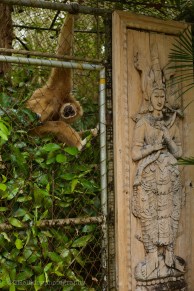
to the cool freshwater stream in the backyard (grab hold of the rope swing and let the clear stream’s current pull you downstream), spacious living quarters, a traveling snack man who pedaled by every morning with fresh treats, a gibbon is what brought us to this house. This gibbon is an abandoned orphan originally from a nearby mountain. He’s now too mature to be a pet and can never go back in the wild. We had fun feeding him fresh fruit, scratching his back, watching him swing, hearing him howl, and were generally entertained by his antics.
 Holliday360